


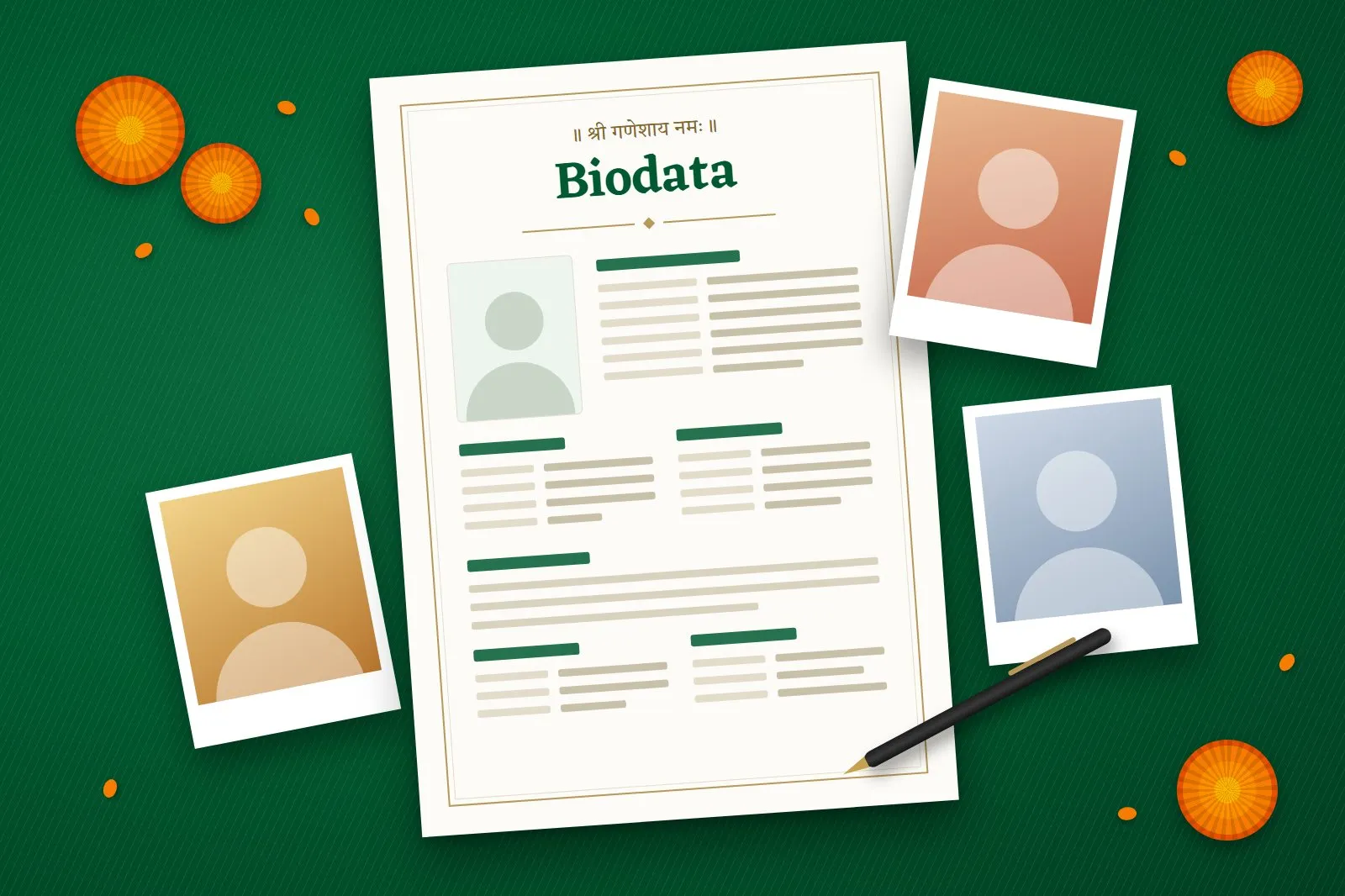
A marriage biodata is a one or two page summary that introduces your son or daughter to another family. A complete biodata covers personal details with the date, time and place of birth, the full home address, education and work, the family on both the paternal and maternal side, a few lines about the person, and what you are looking for in a match. Add three or four clear, recent photos and a contact name. Keep it accurate and easy to read on a phone. The other family will form their first impression from it, so honesty helps far more than decoration.
What should a marriage biodata include?
Most biodatas follow the same broad structure, and families expect to find information in a familiar place. The sections below cover what the other side usually wants to know.
| Section | What to include |
|---|---|
| Personal details | Full name, date of birth, exact time of birth, place of birth, height, complexion if you wish, and diet |
| Address | Full home address, and the city where the person lives now if it is different |
| Education | Highest qualification, college or university, and any professional degree |
| Work | Profession, designation, employer or business, and city of work |
| Paternal family | Grandparents, father’s name and occupation, father’s brothers and sisters, native place, community, sub-community and gotra |
| Maternal family | Mother’s name and occupation, maternal grandparents (nana and nani), mama and mausi, and where the family is from |
| Siblings | Brothers and sisters, what they do, and whether they are married |
| Kundli details | Rashi, nakshatra and Manglik status, if you know them |
| About and expectations | A short paragraph about the person, and a few lines on the kind of match the family is looking for |
| Contact | Name and number of the parent or relative who will take calls |
How much family detail should we give?
Give both sides of the family, paternal and maternal. In an arranged marriage, two families come together, and the other side will want to know who your family is on both sides before they suggest a meeting.
On the paternal side, list the grandparents, the father and his brothers and sisters, with a line on what each does and where they live. On the maternal side, list the nana and nani, the mama and mausi, and where the family is from. Families often know people in common, and a familiar surname on the maternal side can open a conversation faster than anything else on the page. Keep each person to a single line, with name, relation, occupation and city.
How should we describe the boy or girl?
Keep the “about” section to four or five sentences. Write about how the person spends their time, what they value, and how they live day to day. For example, a family might write that their daughter works in finance in Bengaluru, enjoys cooking and classical music, is close to her grandparents and visits home every festival.
Avoid long lists of adjectives such as “caring, loving, understanding, family-oriented”. Every biodata says the same, and they tell the reader very little. One or two specific details give a clearer picture than ten general words.
What should we write about expectations?
This section is short, and it helps the other family decide quickly whether the match could work. Mention the things that genuinely matter to your family, such as community, diet, education, kundli, or the city you would like your son or daughter to settle in.
Be careful not to turn it into a long list of demands. A line like “looking for a well-educated, vegetarian family from the Marwari community, open to Kolkata or Mumbai” is clear and polite. If something is non-negotiable for your family, it is fair to say so plainly.
Which photos work best?
Add three or four photos, so the other family gets a fair idea of how the person looks and carries themselves. A good set is:
- A clear close-up in natural light, with the face easily visible.
- A full-length photo in traditional clothes, such as a saree, lehenga, kurta or sherwani.
- A full-length photo in smart or western clothes.
- A natural, informal photo, at home or on a family outing, where the person looks relaxed.
All the photos should be recent. Photos taken by a friend in good daylight often look better than heavily edited studio pictures. Avoid group photos where it is hard to tell who the person is, sunglasses, filters and very old pictures. The other family will meet your son or daughter in person eventually, so it is better if the photos look like the person they will meet.
What should we leave out of a biodata?
Some information is better shared in conversation once there is interest on both sides. Leave out the following from the first biodata you send:
- Exact salary and family wealth. Profession and employer give enough of a picture. Details can follow privately.
- Identity documents. Never attach Aadhaar, PAN or passport copies to a biodata.
- Anything that is not quite true. Rounding up height, education or income always comes out later, and it damages trust between two families at the very start.
Because the biodata carries your full address and family details, send it to families you know or through your matchmaker, and avoid posting it in large groups where it can be forwarded to strangers.
Why do the date, time and place of birth belong on every biodata?
Include the date of birth, the exact time of birth and the place of birth on every biodata, whether or not your own family follows kundli. Many families do follow kundli, and they will want to prepare and match it before suggesting a meeting. Without the exact time, they cannot. Leaving it out often means a good proposal stops before it starts.
For families who match kundlis, these three details are used to check the Guna Milan, or Ashtakoota, score out of 36. A score of 18 or more is traditionally considered acceptable, though families and pandits weigh it differently. If you know the rashi, nakshatra and Manglik status, add them too. If your family does not follow kundli, you can still give the birth details and write “kundli not required from our side”. Our kundli matching page explains how the traditional matching works.
How should the biodata look?
Plain and readable is best. Use one clear font, simple headings and enough space between sections. Save it as a PDF so the layout does not change when it is opened on another phone, and name the file with the person’s name rather than “biodata final new”.
Read it once on a phone screen before you send it. If you have to zoom in to read the text, the font is too small. Ask a relative to check it for spelling mistakes, and confirm that the son or daughter is comfortable with every line in it.
How we handle this at Pavitra Rishta
At the first meeting, your Relationship Manager goes through your biodata with you and suggests changes where they help. When a proposal fits, we speak to the other family first, and you see only the few profiles that suit you, each with biodata and photos. Your biodata is shared with another family only with your permission, and every proposal is kundli matched unless you opt out. You can read more about the process on our how it works page.
If you would like help preparing a biodata or starting a search for your son or daughter, call us on +91 93303 22220 or schedule a call. We have helped families present their children well since 2006, and we will be glad to look at yours.
Questions families ask
How long should a marriage biodata be?
One to two pages is right for most families. The other family usually reads it on a phone before deciding whether to take the conversation further, so clear headings matter. With birth details, the full address, both sides of the family and three or four photos, two pages is normal. Keep the writing short so the important details are easy to find.
Should we mention salary or family income in the biodata?
Many families mention the profession and the employer, and leave the exact salary for a later conversation. Some prefer to give a range. Either is fine. What matters is that whatever you write is accurate, because the other family will rely on it. If you are unsure, discuss it with your matchmaker, who can share the figure privately once there is mutual interest.
Do we need to give the time of birth if we don't follow kundli?
Yes. The date, exact time and place of birth belong on every biodata. Many families on the other side do follow kundli and will want to match before meeting, and without the time of birth they cannot. Giving these details does not commit your family to anything. You can still write that kundli is not required from your side.
Can the boy or girl write their own biodata?
Yes, and it often reads more naturally when they do. Many families let the son or daughter write the short section about themselves and their expectations, and the parents fill in the family details. It is a good idea for both to read the final version together, so that nothing in it surprises either of them later.
Should we use a biodata template from the internet?
A simple template is fine for the layout. Avoid heavy designs with borders, religious images on every page or decorative fonts, because they are hard to read on a phone. Plain headings, a clear font and good spacing work best. The content matters far more than the design.